
AISEO in 2026: Mastering Context Linking with SyncRanker for Unmatched Authority
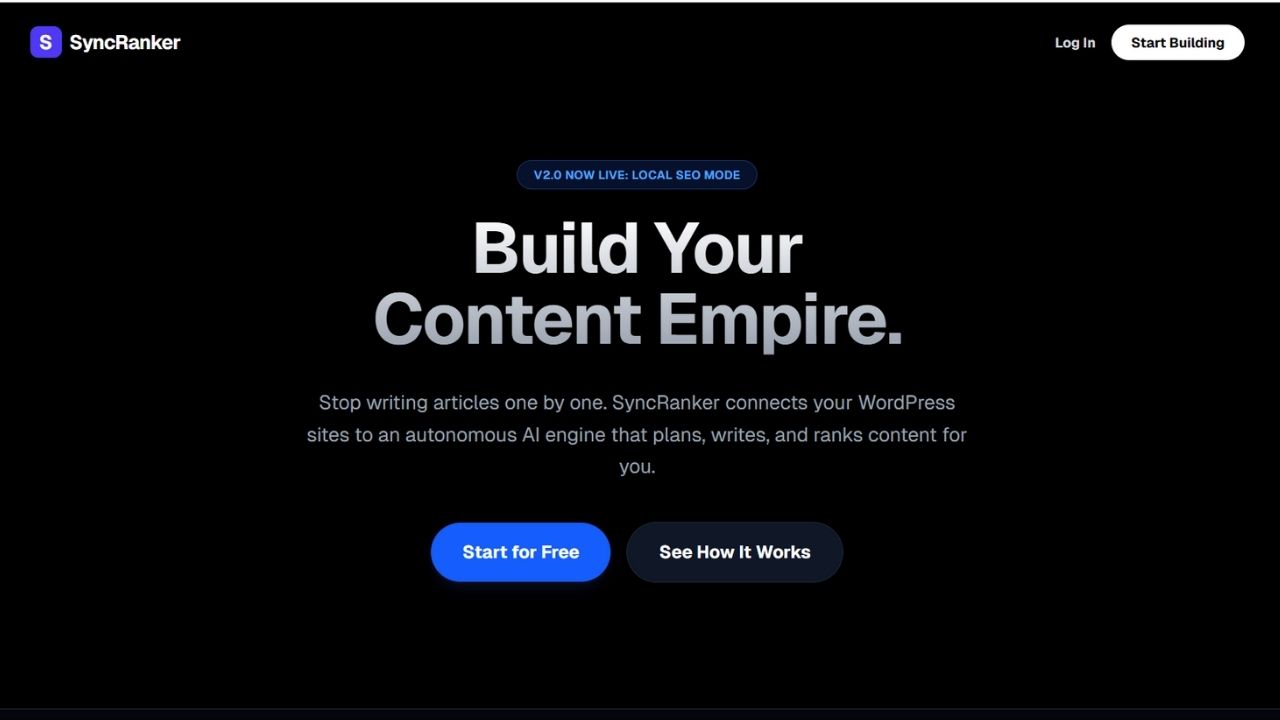
The landscape of Search Engine Optimization (SEO) is in a perpetual state of flux, but never before has it experienced such profound, accelerating transformation as with the advent of advanced Artificial Intelligence. As we look towards 2026, the notion of 'AISEO' moves beyond simple automation; it evolves into a sophisticated dance between machines understanding intent and human architects crafting unparalleled digital experiences. The battle for organic visibility will no longer be won by keywords alone, but by the deep, interconnected web of context your content presents. This is where tools like SyncRanker emerge as indispensable, offering a revolutionary approach to 'context linking' that fundamentally shifts how we build and project authority.
The Evolution of SEO: From Keywords to Context in 2026
For decades, SEO was a game of keywords. Rank for the right terms, and traffic would follow. Then came the semantic web, emphasizing user intent and natural language processing. In 2026, AI has taken this a monumental leap further. Search engines, powered by incredibly advanced Large Language Models (LLMs) and deep learning algorithms, don't just understand intent; they anticipate it. They don't just read words; they construct comprehensive knowledge graphs of topics, entities, and relationships.
This paradigm shift means that isolated pieces of content, no matter how well-written, struggle to compete. What Google (and other search engines) truly values now is a holistic, authoritative understanding of a subject. They seek out domains that don't just cover a topic, but own it entirely, demonstrating expertise, experience, authoritativeness, and trustworthiness (E-E-A-T) through a rich tapestry of interconnected information. AI doesn't just rank documents; it ranks knowledge domains. Your ability to create and demonstrate this interconnected knowledge is the new frontier of SEO.
What is AISEO in 2026? Beyond Automation.
In 2026, AISEO is far more than just using a tool to generate article outlines or rephrase sentences. It’s an integrated strategy where AI assists at every stage of the content lifecycle, from ideation to optimization and distribution, but critically, with human oversight and strategic direction. It's about leveraging AI's analytical power to identify opportunities, streamline processes, and enhance content quality on an unprecedented scale.
- AI for Hyper-Personalized User Intent Analysis: Gone are the days of broad keyword research. AI tools can now analyze billions of search queries, social media conversations, and user behavior patterns to pinpoint hyper-specific, micro-intents that signal emerging trends or unmet information needs.
- AI-Assisted Content Generation & Augmentation: While fully automated, high-quality content generation is still a pipe dream for most complex topics, AI excels at drafting, researching, summarizing, and expanding upon human-created core ideas. It can help bridge language barriers, adapt content for different formats, and even suggest structural improvements for better readability and SEO.
- AI for Proactive Technical SEO: AI-powered crawlers and diagnostics can identify technical SEO issues (crawl budget optimization, schema markup errors, core web vitals bottlenecks) before they become problems, often suggesting and even implementing solutions autonomously.
- AI for Dynamic UX Optimization: AI analyzes user interactions (scroll depth, time on page, conversion paths) to dynamically suggest improvements to content layout, internal linking, call-to-actions, and overall page experience, leading to higher engagement and better rankings.
- AI for Predictive Analytics and Strategy: The most significant shift is AI's ability to predict future search trends, algorithm updates, and competitor moves, allowing SEOs to develop proactive strategies rather than reactive ones.
The essence of AISEO in 2026 is collaboration: AI handles the heavy lifting of data analysis, pattern recognition, and scalable assistance, while human experts provide the creativity, ethical judgment, strategic vision, and critical fact-checking.
The Limitations of Traditional AI Content Optimization
Despite the advancements, current AI tools often fall short in specific areas, creating a 'sea of sameness' problem. While they can generate grammatically correct, coherent text, they frequently lack:
- Deep Domain Expertise: AI models learn from vast datasets, but they don't truly 'understand' a topic in the way a human expert does. This can lead to superficial content that scratches the surface but fails to provide genuine, novel insights.
- Originality and Unique Perspective: AI often synthesizes existing information. Without careful human guidance, its output can lack a unique voice, fresh angles, or truly original research, making it difficult to stand out in a crowded search landscape.
- Contextual Nuance and Semantic Depth: While LLMs are good at understanding individual sentences and paragraphs, truly understanding how different pieces of information relate across an entire website or even across multiple domains — creating a rich, interconnected web of knowledge — remains a challenge for general-purpose AI. This is especially true for internal linking, which is often done mechanically rather than semantically.
- Strategic Intent Mapping: Current AI struggles with the strategic intent behind content creation – how a piece fits into a broader content marketing funnel, supports a specific business goal, or builds long-term topical authority. This requires a higher level of strategic thinking.
These limitations highlight the gap between AI-assisted content and truly authoritative, deeply contextual content. This gap is precisely what SyncRanker aims to bridge.
Introducing SyncRanker: Redefining Content Authority with Context Linking
SyncRanker is not just another AI content tool; it's an AI-powered content architecture platform designed specifically for headless CMS environments in the age of semantic search. Its core innovation lies in its ability to analyze your entire content ecosystem, understand the relationships between individual content pieces, and then dynamically and intelligently 'context link' them to build unparalleled topical authority.
Think of your website not as a collection of pages, but as a knowledge graph. SyncRanker's mission is to make that knowledge graph explicit, coherent, and highly navigable for both search engines and users. It moves beyond traditional internal linking, which is often manual, sporadic, or based on simple keyword matches, to a sophisticated system driven by semantic relevance and user intent.
The premise is simple: When search engines see a deeply interconnected web of content, where every piece naturally references and supports related pieces, they recognize a true authority on a subject. SyncRanker makes this process scalable, precise, and powerful.
Deep Dive into Context Linking: The SyncRanker Advantage
Context linking, as implemented by SyncRanker, is the evolution of internal linking. It's about creating a seamless, semantically rich network of content that guides users and search engine crawlers through your expertise. It's how you signal to Google that you truly own a topic, not just mention it.
Entity Recognition and Graph Databases
SyncRanker's foundation is its sophisticated entity recognition engine. It doesn't just extract keywords; it identifies specific entities (people, places, concepts, products, events) within your content and across the broader web. These entities are then mapped into a proprietary knowledge graph database. This graph visually represents how every piece of content, every section, and every entity on your site relates to others. For instance, an article about 'serverless functions' might be linked not just to 'cloud computing' but also to 'AWS Lambda,' 'microservices architecture,' and 'cost optimization strategies,' each representing a distinct entity within your knowledge base. This detailed mapping ensures that links are highly relevant and enrich the user's understanding. [INTERNAL_LINK_PLACEHOLDER: The Power of Knowledge Graphs in SEO]
Semantic Cohesion Scores
Beyond identifying entities, SyncRanker calculates a 'Semantic Cohesion Score' for your content. This score measures how deeply and broadly a piece of content covers a specific topic relative to other relevant content on your site and competitor sites. It assesses the density and relevance of related entities, concepts, and sub-topics, ensuring that your content isn't just long, but truly comprehensive and interconnected. High cohesion scores indicate high topical authority, a critical ranking factor in 2026.
Predictive Content Gaps
One of SyncRanker's most powerful features is its ability to identify predictive content gaps. By analyzing your existing content graph against competitor knowledge graphs and emerging search trends, SyncRanker can proactively suggest new content topics or expansions to existing ones that would significantly enhance your topical authority and fill critical gaps in your semantic coverage. It doesn't just tell you what's missing; it tells you what *should* be linked to future content.
Dynamic Internal Linking
This is where context linking truly shines. Based on the knowledge graph and semantic cohesion scores, SyncRanker dynamically suggests or even automates the placement of highly relevant internal links within your content. These aren't just arbitrary links; they are intelligent connections that:
- Guide users to more detailed information, improving time on site and reducing bounce rates.
- Pass link equity (PageRank) strategically to important cornerstone content and emerging topics.
- Signal to search engines the depth of your expertise and the relationships between your content pieces.
- Adapt in real-time as new content is published or search trends evolve.
Implementing AISEO with SyncRanker: A Step-by-Step Strategy for 2026
Integrating SyncRanker into your headless CMS workflow transforms your content strategy from a series of isolated articles into a unified, authoritative knowledge hub. Here’s how to do it:
Phase 1: Foundational Content Audit and Entity Mapping
Begin by feeding all your existing content into SyncRanker. The platform will then perform a comprehensive audit, identifying key entities, existing links, content gaps, and initial semantic cohesion scores. This process creates your baseline knowledge graph, highlighting areas of strength and weakness.
Phase 2: Strategic Content Creation with AI and SyncRanker
Leverage generative AI for initial drafts or research, but crucially, use SyncRanker's insights to guide the content brief. SyncRanker will suggest not just keywords, but entire clusters of related entities and sub-topics that need to be covered to achieve a high semantic cohesion score. For example, if you're writing about 'edge computing,' SyncRanker might recommend including sections on 'latency reduction,' 'IoT devices,' and 'decentralized data processing' to ensure comprehensive coverage. [INTERNAL_LINK_PLACEHOLDER: Crafting Effective Content Briefs with AI]
Phase 3: Optimizing for Context with Dynamic Linking
As you publish new content, SyncRanker's real-time analysis identifies optimal internal linking opportunities. Instead of manually searching for related articles, SyncRanker automatically suggests precise anchor texts and target pages that will enhance topical authority. For a headless CMS, this integration can be seamless, with SyncRanker providing API endpoints to inject these intelligent links directly into your content rendering pipeline. This ensures your internal link structure is always optimized and adapting.
Phase 4: Continuous Iteration and Predictive Expansion
SyncRanker is not a set-it-and-forget-it tool. Its analytics dashboard provides ongoing insights into how your context links are performing, which content clusters are gaining authority, and where new opportunities lie. Use these predictive insights to plan your next content pieces, expanding your knowledge graph in a strategically sound way that anticipates future search demand and strengthens your overall domain authority. This iterative process is key to long-term SEO success in 2026.
[IMAGE_BODY3]Measuring Success in the AISEO Era with SyncRanker
Traditional SEO metrics like keyword rankings remain important, but in 2026, a more holistic view of success is crucial. SyncRanker helps you track:
- Topical Authority Score: A proprietary metric indicating your domain's expertise and depth on specific topics, derived from your knowledge graph's density and interconnectedness.
- Internal Link Equity Flow: Visualize how link value is distributed across your site, ensuring your most important content receives the appropriate authority signals.
- Content Gap Closure Rate: Track how effectively you are addressing identified content gaps and expanding your topical coverage.
- User Engagement Metrics (Enhanced): By guiding users through a more logical content journey, SyncRanker indirectly improves time on site, pages per session, and conversion rates, which are all strong signals to search engines.
- E-E-A-T Performance: SyncRanker's emphasis on comprehensive, interconnected content directly contributes to demonstrating higher Expertise, Experience, Authoritativeness, and Trustworthiness.
Measuring these advanced metrics provides a clearer picture of your long-term organic performance and how effectively you are building a sustainable competitive advantage.
Challenges and Future Outlook for AISEO and Context Linking
While the future of AISEO with tools like SyncRanker is incredibly promising, it's not without its challenges. The pace of AI development means constant adaptation is necessary. Staying ahead of algorithm updates requires continuous monitoring and a willingness to iterate rapidly. Ethical considerations surrounding AI-generated content, such as factual accuracy, bias, and the potential for misinformation, will also demand careful human oversight and robust verification processes. [INTERNAL_LINK_PLACEHOLDER: Ethical Considerations in AI Content Generation]
Ultimately, the role of the human SEO content architect becomes even more vital. AI provides the tools and the insights, but the strategic vision, the creativity, the unique voice, and the critical judgment remain firmly in human hands. SyncRanker doesn't replace the strategist; it empowers them to build digital empires of knowledge that are both deeply authoritative and effortlessly navigable.
Conclusion
The year 2026 marks a significant inflection point in SEO. The ability to simply 'write content' or 'optimize keywords' will no longer suffice. Success will be defined by your capacity to build comprehensive, semantically rich knowledge hubs that demonstrate unparalleled topical authority. Tools like SyncRanker, with their revolutionary approach to context linking, provide the leverage needed to navigate this new era of AISEO.
By transforming your content from disparate pages into an intelligent, interconnected network, SyncRanker allows you to speak to search engines in the language they now truly understand – the language of context and relationships. Embrace AISEO with SyncRanker, and future-proof your digital presence for an organic advantage that goes beyond rankings, building a lasting foundation of expertise and trust.